US Navy's Wall-Climbing Robots Are Reinventing Ship Hull Inspection
The US Navy is deploying wall-climbing robots for ship hull inspection, merging robotics with structural assessment in ways that reshape defense infrastructure maintenance.
By TSS Team
The Problem With Ship Hull Inspection
A modern naval warship is, in structural engineering terms, one of the most complex mobile structures ever built. The hull of a destroyer or aircraft carrier must withstand enormous hydrostatic pressure, constant saltwater corrosion, mechanical vibration from propulsion systems, and the physical stress of high-speed maneuvering in rough seas. Over time, these forces cause fatigue cracks, corrosion pitting, coating degradation, and weld failures that can compromise structural integrity. Traditionally, inspecting a ship hull requires dry-docking — pulling the vessel out of the water and into a specialized facility where human inspectors physically examine every section of the hull surface. This process is extraordinarily expensive, taking weeks to complete and costing millions of dollars per vessel. During dry-dock inspection, the ship is entirely out of service, reducing fleet readiness. For the US Navy, which maintains a fleet of approximately 300 deployable ships, the logistics of routine hull inspection represent a significant operational and financial burden. The challenge is compounded by the fact that many structural defects — micro-cracks, subsurface corrosion, and coating delamination — are invisible to the naked eye and require specialized sensing equipment to detect.
Enter the Wall-Climbing Robots
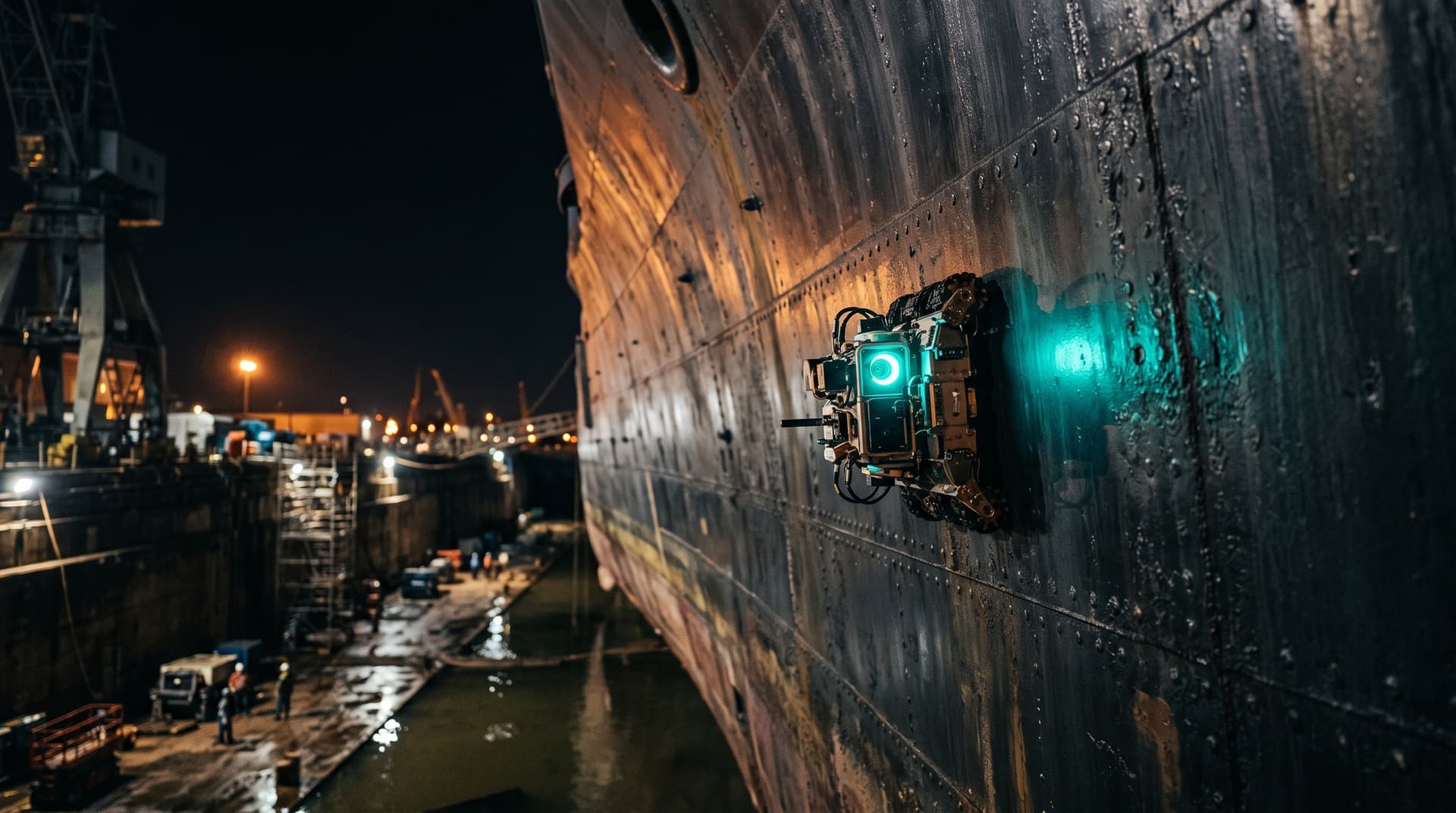
The US Navy's solution is a new generation of wall-climbing robots designed specifically for in-water hull inspection. These robots use magnetic adhesion or vacuum-based suction systems to traverse the curved, often fouled surfaces of ship hulls while the vessel remains in the water. Equipped with an array of sensors — including ultrasonic thickness gauges, eddy current detectors, high-resolution cameras, and corrosion mapping systems — these robots can perform comprehensive structural assessments without requiring dry-docking. The robots are operated remotely, allowing inspection teams to survey the hull from a control station while the robot navigates autonomously or semi-autonomously across the hull surface. Advanced machine learning algorithms process the sensor data in real time, flagging areas of concern and generating detailed structural health maps. Some systems can even perform basic surface preparation and coating assessment, further reducing the need for manual intervention. The result is a dramatic reduction in inspection time — from weeks to days — and a corresponding reduction in cost. More importantly, the robots enable more frequent inspections, allowing the Navy to shift from a reactive maintenance model to a predictive one. Structural problems are caught earlier, when they are cheaper and easier to repair, rather than being discovered during scheduled dry-dock periods.
Robotics Meets Structural Engineering
What makes these wall-climbing robots particularly interesting from a TSS perspective is not just the robotics — it is the integration of robotics with structural engineering principles. The sensor suites on these robots are essentially performing non-destructive evaluation (NDE) at scale, using techniques that were previously confined to laboratory settings or highly controlled inspection environments. Ultrasonic testing, which measures material thickness by timing the echo of high-frequency sound waves, can detect internal corrosion and fatigue damage that is completely invisible from the surface. Eddy current testing identifies surface and near-surface cracks in conductive materials. When these techniques are combined with computer vision and AI-based analysis, the result is a structural assessment capability that exceeds what human inspectors can achieve — even highly experienced ones. This convergence of robotics and structural engineering has implications far beyond naval applications. The same technologies can be applied to bridges, dams, offshore platforms, nuclear facilities, and any large structure where manual inspection is dangerous, expensive, or impractical. The fundamental challenge — assessing the structural health of a large, complex surface — is the same whether the surface is a ship hull, a dam face, or a building facade.
Implications for Defense Infrastructure
For defense organizations worldwide, wall-climbing inspection robots represent a significant shift in how military infrastructure is maintained. Naval vessels are just the beginning. Military bases, airfield runways, ammunition storage bunkers, radar installations, and underground command facilities all require regular structural inspection. In many cases, these inspections are deferred due to cost, logistical complexity, or operational constraints — creating hidden structural risks that can compromise readiness. Robotic inspection systems offer a path to more comprehensive, more frequent, and less disruptive structural assessment across the entire defense infrastructure portfolio. For India's navy, which is undergoing a significant expansion — including new aircraft carriers, destroyers, and submarines — the adoption of robotic hull inspection could dramatically improve maintenance efficiency and fleet availability. India's naval infrastructure, including ports, dry-docks, and coastal defense installations, would also benefit from robotic structural monitoring. The broader Indian defense establishment, managing thousands of structures across the country, stands to gain enormously from the maturation of these technologies.
TSS's Perspective: Where Defense Meets Structural Innovation
At TSS, the intersection of defense and structural engineering is one of our founding focus areas. The US Navy's wall-climbing robots exemplify exactly the kind of convergence we believe will define the future of infrastructure maintenance: autonomous systems performing sophisticated structural assessment at scale, guided by AI, and delivering actionable intelligence to human decision-makers. We are studying how similar robotic inspection technologies can be adapted for India's infrastructure context — not just for naval applications, but for bridges, dams, high-rise buildings, and defense installations. The core engineering challenges are the same: how do you assess the structural health of a large, complex structure quickly, accurately, and affordably? Our work in AI-driven structural analysis is directly relevant here. The sensor data generated by inspection robots is only as valuable as the algorithms that interpret it. TSS is exploring how machine learning models can be trained on structural inspection data to identify patterns that predict failures before they occur — enabling truly predictive maintenance for critical infrastructure.
The Future of Structural Inspection
The US Navy's wall-climbing robots are an early indicator of a much larger transformation in how we maintain built infrastructure. Within the next decade, robotic inspection will move from specialized military applications to mainstream infrastructure maintenance. Bridges will be inspected by climbing robots instead of bucket trucks. Dams will be surveyed by autonomous underwater vehicles instead of divers. Buildings will be assessed by drone-mounted sensor arrays instead of scaffolding-dependent manual inspection. The organizations that develop expertise in this intersection — robotics, structural engineering, AI, and defense — will be positioned to lead this transformation. The technology is maturing rapidly. The question is not whether robotic structural inspection will become standard practice, but which organizations will develop the engineering capability to deploy it effectively. At TSS, we believe India should be at the forefront of this shift.
Official sources & further reading
The future of structural inspection is autonomous, intelligent, and already climbing the walls.